Conference ATypI Paris 2023
You’re invited to celebrate all things in typography and type design! Join us in the fabulous city of Paris, as we celebrate being together and taking part of the latest discourses in typography and type design from all over the world. This will be our sixty-seventh annual conference of the non-profit Association Typographique Internationale. So mark your calendars for May 9-14, 2023, and join us as we travel to the incroible City of Light!
| 15:00–15:30 |
Caractère Noël, 1951-1964: The manufacture of typographic discourse in FranceTaking as a starting point the special issues of the magazine Caractère Noël (1951-1964) and Maximilien Vox’s dual role as editor-in-chief and artistic director, this work is based on the study of various editorial corpuses and archive collections. It aims to analyze the establishment of a space for public discussion around graphic design and the… Continue reading Caractère Noël, 1951-1964: The manufacture of typographic discourse in France |
||
| 11:30–12:00 |
Exploring Commonality in Four Different Type Systems: Discovering how words in English, Mandarin, Hindi, and Urdu type can cross the cultures barriersSince the beginning, from cave paintings to modern languages, humans have developed written forms to communicate using symbols to visually convey messages and meaning. In this study, four dramatically different languages will be explored and compared in terms of their unique rules. The four languages in particular are English, Mandarin, Hindi, and Urdu. This study… Continue reading Exploring Commonality in Four Different Type Systems: Discovering how words in English, Mandarin, Hindi, and Urdu type can cross the cultures barriers |
||
| 10:30–11:00 |
Chinese Font Design and Application Trends in the 2020sFoundertype is the world’s largest Chinese foundry and the largest foundry in China. While providing font services for many fields such as publishing, printing, packaging, advertising, Internet, software and hardware facilities through continuous font design, font development, font cooperation, customer service, and business association, Foundertype is also deeply observing the changing trends of the Chinese… Continue reading Chinese Font Design and Application Trends in the 2020s |
||
| 10:00–10:30 |
Arabic/Latin—Designed in dialogThree main aspects distinguish 29LT Okaso and Ada type projects: 1st, intriguing research topics. 2nd, bi-script creative design process, and 3rd, use of the latest available type technology (Variable Fonts and Advanced Opentype) to best render the fonts. Looking at the starting point and the final visual outcome, the two projects presented could not be… Continue reading Arabic/Latin—Designed in dialog |
||
| 09:30–10:00 |
Typography for the MetaverseThis group presentation will showcase a case study of Project Mariah—an augmented reality (AR) experience that challenges societal power systems, including big tech and big pharma, by “hacking the metaverse” as an act of protest. Mariah narrates stories of historical injustice through the backdrop of significant cultural institutions and the corrupt funding that has allowed… Continue reading Typography for the Metaverse |
||
| 09:00–09:30 |
Typographic Imaginary of Louis JouLouis Jou was a Catalan engraver who founded his own private press in 1920 at Les Baux de Provence. I’m now revisiting his archives and reviving his types. |
||
| 16:00–16:30 |
Back to AlifAlif is the beginning, the first letter of the Arabic alphabet. Transformation in the Arabic script styles could be observed in the Alif of each script where, with different measures and the vertical elevation of the letter, the signature of the style can be detected. The Alif acts as the symbol of the script through… Continue reading Back to Alif |
||
| 15:30–16:00 |
Urban Letterforms and Social Representation: Investigating the intersection of visual communication and sociolinguisticsLanguage is the means by which people present themselves and relate to each other. The form and materiality of typographically designed language in urban spaces allow sign producers to express how they see themselves and how they want to be perceived. Typographic choices indicate cultural identities, show social positioning, communicate values, reference social groups, and… Continue reading Urban Letterforms and Social Representation: Investigating the intersection of visual communication and sociolinguistics |
||
| 11:30–12:00 |
The Pergamon ProjectThe Anatolian continent, also known as Asia Minor, is a cultural geography that has hosted various civilisations for thousands of years. Mysia, an ancient region located in the northwest of this region, hosted the significant ancient Greek city of Pergamon from the 3rd century BCE until the 3rd century CE. The Pergamon project is a… Continue reading The Pergamon Project |
||
| 12:30–13:00 |
Why We Don’t Know Anything About the History of Ukrainian DesignThe Lecture will tell why we do not know as many facts about Ukrainian design as we might expect. We will analyze the reasons why it is discussed only as an emerging phenomenon and why that viewpoint is a postcolonial mistake. Were there schools or unions in Ukrainian design? How did Soviet censorship affect the… Continue reading Why We Don’t Know Anything About the History of Ukrainian Design |
 Juanma Gomez
  Anosh Gill
  Yichen Zhang
  Linda Hintz
  Pascal Zoghbi
  Toshi Omagari
  Adam DelMarcelle
  Flor Salatino
  Heather Snyder Quinn
  Zishou Wang
 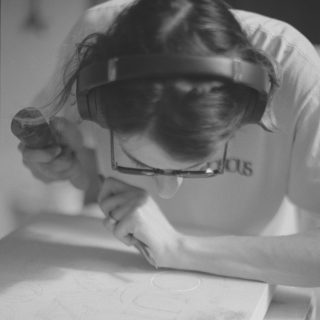 Jules Durand
  Nada Abdallah
  Irmi Wachendorff
  Onur Yazıcıgil
  Oleksandra Korchevska-Tsekhosh