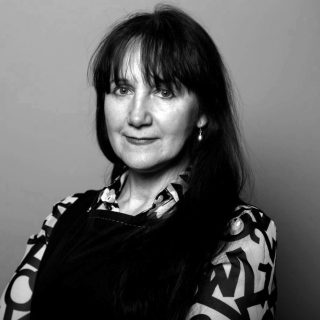
 Ausra Lisauskiene
 I would like to tell you some stories in which letters were the main characters, helping to preserve the Lithuanian language and culture. The first story concerns the smuggling of letters. In the 19th century, the printing of books in Lithuanian characters was banned by order of the Tsar. Instead, the Latin characters in books were replaced with Cyrillic. But a solution was found. Lithuanian smugglers took books across the border of the Russian Empire and distributed them to Lithuanians.
The second is a detective story. In Soviet-occupied Lithuania, when all press was censored, two printers printed books in an underground printing house under a greenhouse. The letters and printing equipment were collected from different printing houses, so it was impossible to trace where the letters came from.
The third story is about the memory of letters. It is the story of an eighteen-year-old man who set himself on fire in protest against the Soviet regime. His drastic act galvanised anti-Soviet sentiment, sparked huge youth riots, and gave hope that Lithuania would be free. That sense of hope has been smoldering in me.
In 2022, I was invited to be a graphic designer for an exhibition. Among my old drawings, I found these scissor-cut letters in the shape of a “saw,” which reminded me of the protest posters of those riots. These letters, cut out by a child’s hand, became the bearers of wisdom in the exhibition “1972. Breaking through the Wall,” which was dedicated to the youth resistance against the Soviet occupation. The cut letters were the key design elements I used to create the typeface UROBORAS. The design is a little severe, like an axe, but it reproduces the spirit of that period some 50 years ago. The typeface has become an important element in our culture.