 Héctor Mangas Afonso
 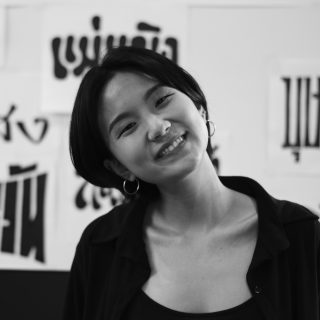 Mint Tantisuwanna
 The debate over looped and loopless fonts in Thai typography has been a long-standing discussion among designers and font users. At the time of writing, there is no fundamental research to help make a clear decision about how loops affect both legibility and readers’ attitudes. Do loops make text easier or harder to read? Does this apply to both distance reading and continuous reading? Does popularisation of of loopless fonts and the reader’s age influence the readability of loops? And can the associations that come with the choice of the font be studied too? We decided to conduct a study to answer these questions.
Three experiments, looking at reading acuity, reading speed and perception of loops, revealed insightful results that align with previous typographical knowledge about this unique feature of the Thai script. The study, which was performed in Bangkok in February of 2024, informed the design of a new launch of Thai fonts by Typotheque. During the talk, both the research and the design of the fonts will be discussed, with input from relevant team members.
The results of our research show that age significantly impacts reading performance, with younger readers preferring loopless fonts at smaller sizes. Although reading performance was not affected by the presence of loops, all age groups perceive looped fonts as more legible, especially in information-dense mediums like books and websites.
Moreover, the perception of other markers was mapped, like noun associations to loops, and preference for each text style. This research devises, for the first time, a complete perceptual mapping to this specific feature of the script.